Atomic Gameboard. 原子双六Main MenuIntroductionThe First 4 Blocks (Bottom Row)Blocks 5 to 7 (Far Right Row)Blocks 8 to 10 (Top Row)Blocks 11 to 13 (Far Left Row)Blocks 14 to 16 (Second Row Up)Blocks 17 & 18 (Middle Right Row)Blocks 19 to 21 (The Last Corner)The Winning GoalBonus: Yellow LanesResources for Teaching and LearningPlay at Home Printout, Cross-Curricular Educational Modules, Key Terms, and Further ReadingAbout the AuthorsJordan Embreec6b3373c765e993c0d9d824105a2289dbdc7f25cAnn Marie L. Davis59abe24a2774467ec5ea91b075faa47a084ef840
Agari Panel Two Yellow
1media/SugorokuAgariYellowPastelBlock2_thumb.jpg2020-11-28T22:31:45+00:00Ann Marie L. Davis59abe24a2774467ec5ea91b075faa47a084ef84011plain2020-11-28T22:31:45+00:00Ann Marie L. Davis59abe24a2774467ec5ea91b075faa47a084ef840
This page is referenced by:
1media/SugorokuNobelPrizes.jpgmedia/SugorokuBlock21.jpgmedia/SugorokuNobelPrizes.jpg2020-11-28T21:55:49+00:00The Nobel Prize in Physics (1901-1949)15plain2021-01-04T03:55:51+00:00
The Complete List of Recipients of the Nobel Prize in Physics
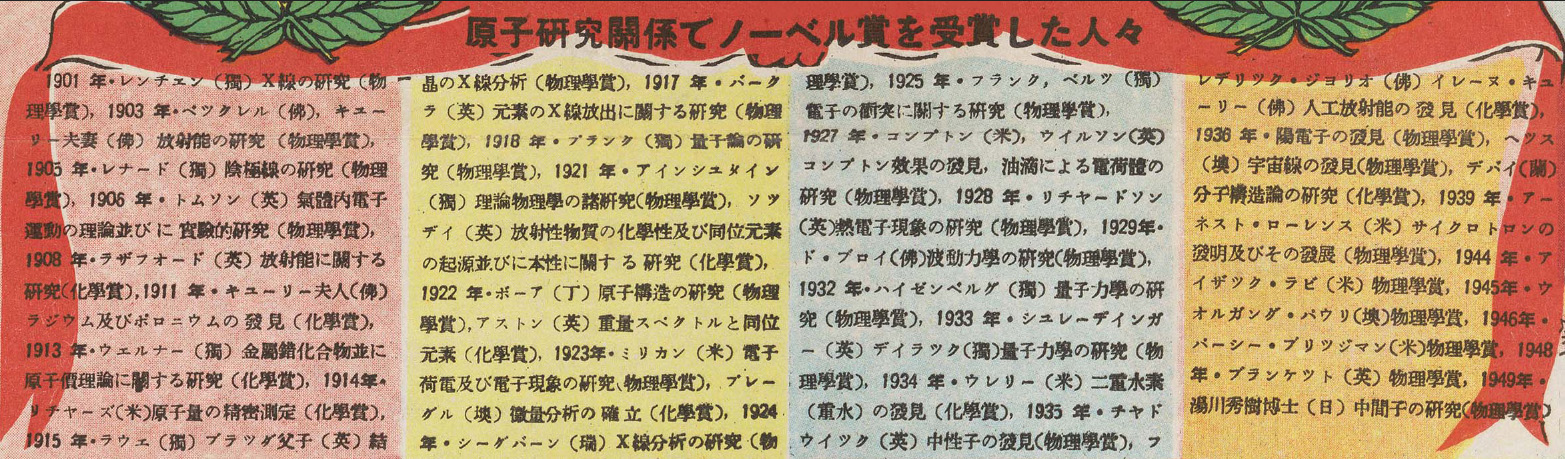
In this final section of the game, players find a complete list of all previous recipients of the Nobel Prize who conducted research in particle physics prior to Yukawa Hideki's award in 1949. Scroll down to each of the images below to zoom in and read who won the prize, starting with Wilhelm Conrad Röntgen in 1901. Recipients came from many different countries, including Germany, Britain, and the United States, but none before Yukawa Hideki came from Japan. Yukawa was not only the first Asian to win the Nobel Prize in Physics, but he was also the first recipient from outside of Euro-America, which was until then the center of scientific research.
Please see the images below to study each of the individual panels in this fascinating timeline.
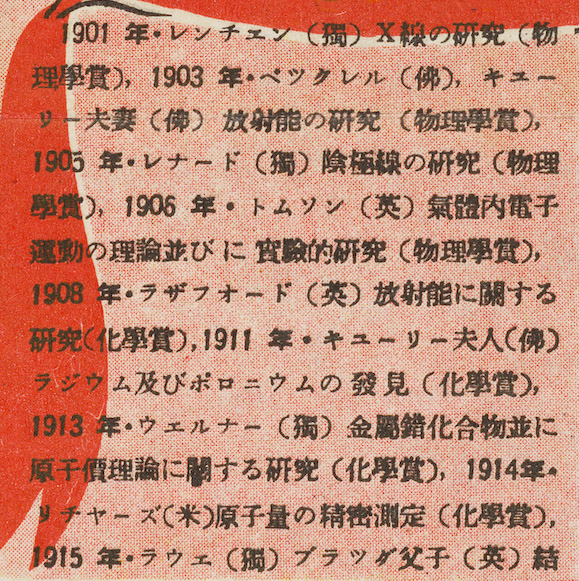
Panel 1
1901 · Röntgen (Germany) X-ray research (Nobel Prize in chemistry), 1903 · Becquerel (France), Lady Curie (France) Research in radioactivity (Nobel Prize in physics), 1905 · Lenard (Germany) Research in cathode rays (Nobel Prize in physics), 1906 · Thompson (Britain) Research in conduction of electricity by gasses (Nobel Prize in physics), 1908 · Rutherford (Britain) research into radioactivity (Nobel Prize in chemistry), 1911 · Lady Curie (France) Discovery of radium and polonium (Nobel Prize in chemistry), 1913 · Werner (Germany) Research of linkage of atoms in molecules (Nobel Prize in chemistry), 1914 · Richards (United States) Accurate determinations of atomic weight (Nobel Prize in chemistry), 1915 · Laue (Germany) Father and son Bragg (Britain)
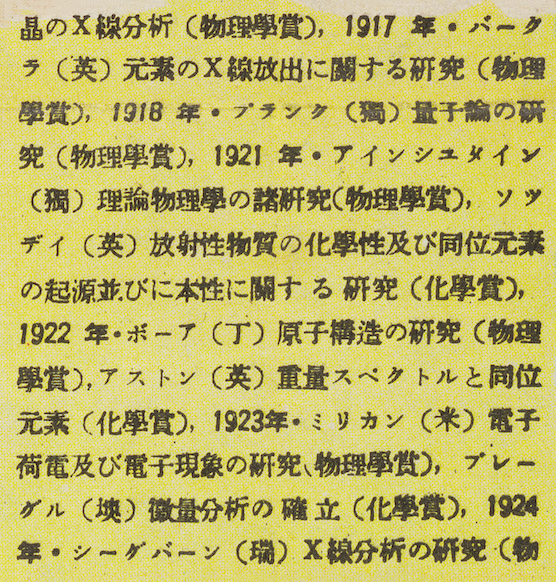
Panel 2
Analysis of crystal structure via X-ray (Nobel Prize in physics), 1917 * Barkla (English) Discovery of Röntgen radiation of elements (Nobel Prize in physics), 1918 * Planck (German) Research in quantum theory (Nobel Prize in physics), 1921 * Einstein (German) Variety of research in theoretical physics (Nobel Prize in physics), Soddy (English) Research in chemistry of radioactive substances and origin of isotopes (Nobel Prize in chemistry), 1922 * Bohr (Danish) Research in the atomic model (Nobel Prize in physics), Aston (English) Usage of spectrograph to find isotopes (Nobel Prize in chemistry), 1923 * Millikan (American) Research in photoelectric effect and the elementary charge of electricity (Nobel Prize in physics), Pregl (Austrian) Established method of microanalysis of organic substances (Nobel Prize in chemistry), 1924 * Siegbahn (Swedish) Research in X-ray spectroscopy (Nobel
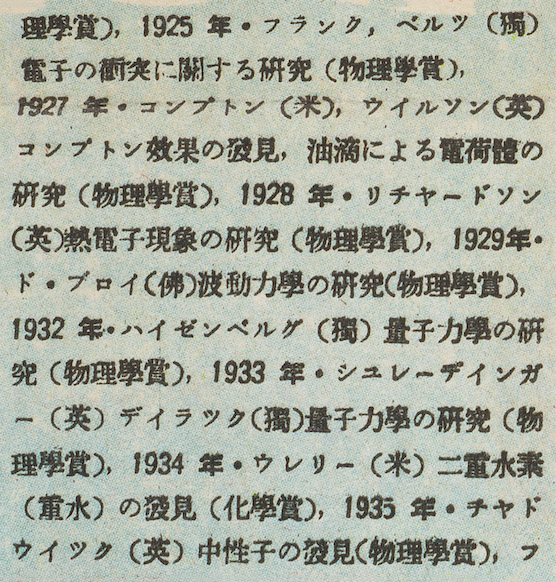
Panel 3
Prize in Physics), 1925 · Franck, Hertz (Germany) Research in electron impacting an atom (Nobel Prize in Physics), 1927 · Compton (United States), Wilson (Britain) Discovery of the Compton effect, Research in seeing charged particles in vapor condensation (Nobel Prize in Physics), 1928 · Richardson (Britain) Research in thermionic phenomenon (Nobel Prize in Physics), 1929 · de Broglie (France) Research in the wave nature of electrons (Nobel Prize in Physics), 1932 · Heisenberg (Germany) Research in quantum mechanics (Nobel Prize in Physics), 1933 · Schrödinger (Britain) Dirac (Germany) Research in atomic theory (Nobel Prize in Physics), 1934 · Urey (United States) Discovery of the origin of deuterium (heavy water) (Nobel Prize in Chemistry), 1935 · Chadwick (Britain) Discovery of the neutron (Nobel Prize in Physics) F[rederick]
Panel 4
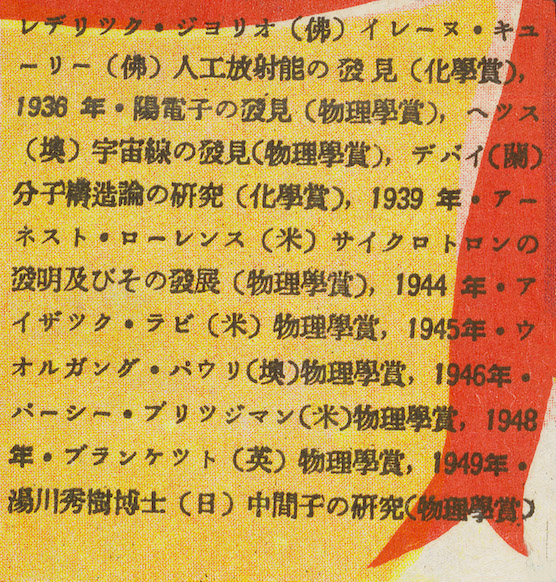
[F]rederick · Joliot (France) Irene · Curie (France) Discovery of artificial radiation (Nobel Prize in Chemistry), 1936 · Discovery of positron, (Nobel Prize in Physics), Hess (Austria) Discovery of cosmic rays (Nobel Prize in Physics), Debye (Netherlands) Research into molecular geometry (Nobel Prize in Chemistry), 1939 · Ernest · Lawrence (United States) The first usage of the cyclotron (Nobel Prize in Physics), 1944 · Isaac · Rabi (United States) Nobel Prize in Physics, 1945 · Wolfgang · Pauli (Austria) Nobel Prize in Physics, 1946 · Percy · Bridgeman (United States) Nobel Prize in Physics, 1948 · Blanchette (Britain) Nobel Prize in Physics, 1949 · Professor Yukawa Hideki (Japan) Research into mesons (Nobel Prize in Physics)