Atomic Gameboard. 原子双六Main MenuIntroductionThe First 4 Blocks (Bottom Row)Blocks 5 to 7 (Far Right Row)Blocks 8 to 10 (Top Row)Blocks 11 to 13 (Far Left Row)Blocks 14 to 16 (Second Row Up)Blocks 17 & 18 (Middle Right Row)Blocks 19 to 21 (The Last Corner)The Winning GoalBonus: Yellow LanesResources for Teaching and LearningPlay at Home Printout, Cross-Curricular Educational Modules, Key Terms, and Further ReadingAbout the AuthorsJordan Embreec6b3373c765e993c0d9d824105a2289dbdc7f25cAnn Marie L. Davis59abe24a2774467ec5ea91b075faa47a084ef840
Blocks Five to Seven
1media/SugorokuBlocks5-7_thumb.jpg2020-11-27T19:07:22+00:00Ann Marie L. Davis59abe24a2774467ec5ea91b075faa47a084ef84011plain2020-11-27T19:07:22+00:00Ann Marie L. Davis59abe24a2774467ec5ea91b075faa47a084ef840
This page is referenced by:
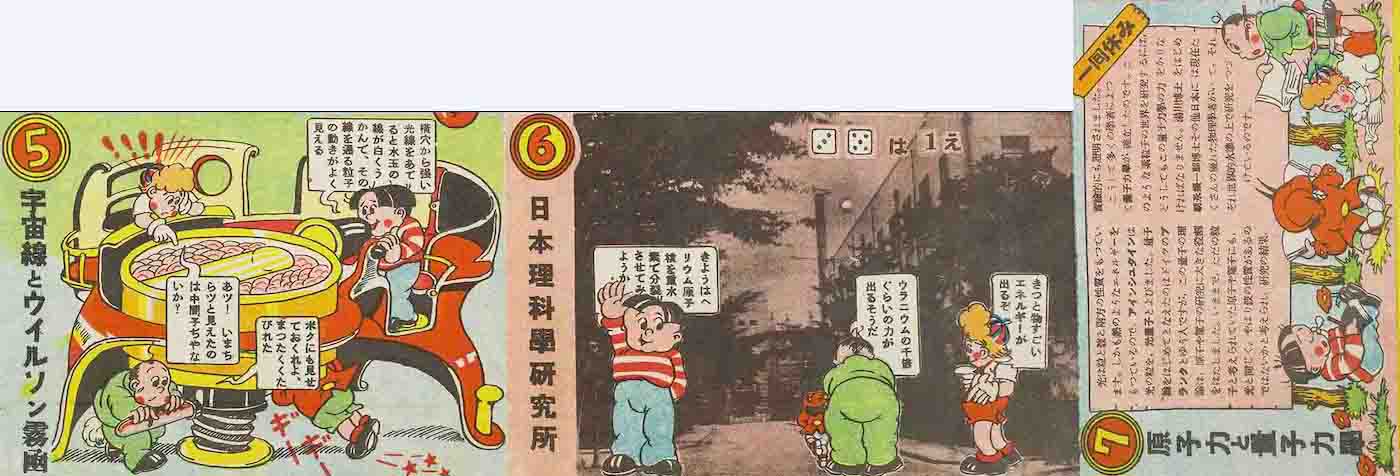
1media/SugorokuBlocks5-7.jpgmedia/SugorokuBlock4.jpgmedia/SugorokuBlocks5-7.jpg2020-11-27T04:37:32+00:00Blocks 5 to 7 (Far Right Row)20visual_path762020-12-24T20:23:45+00:00 The next three blocks (5-7) introduce the notion of cosmic rays, which among other nuclear phenomena, came to be studied with the Wilson cloud chamber. Invented by Scottish physicists C.T.R Wilson and Arthur Compton, this radiation detector earned the duo the Nobel Prize in 1927. As the invention was coming out, Japan saw the establishment of a major national science research institute in Tokyo. Identified on the gameboard as the Japan Institute of Physical and Chemical Research (Nihon Rikagaku Kenkyūsha), this institution is known today by the acronym RIKEN. Block 7 relates that Japanese scientists like Yukawa Hideki, Tomonaga Shinichirō, and many others, were among the top researchers in the world who advanced this new - and literally "powerful" - field of quantum mechanics.